
Health Library / Training
This content is for education only and is not medical advice. I'm a fitness coach, not a physician. Talk to your doctor before starting any medication, hormone, supplement, or new exercise program, especially if you have a medical condition or take prescriptions.
Most home gyms are bought in the wrong order. People start with the cardio machine, which becomes a clothes rail, and never buy the thing that would have changed their body.
Here's the order that works, and you can stop at any point.
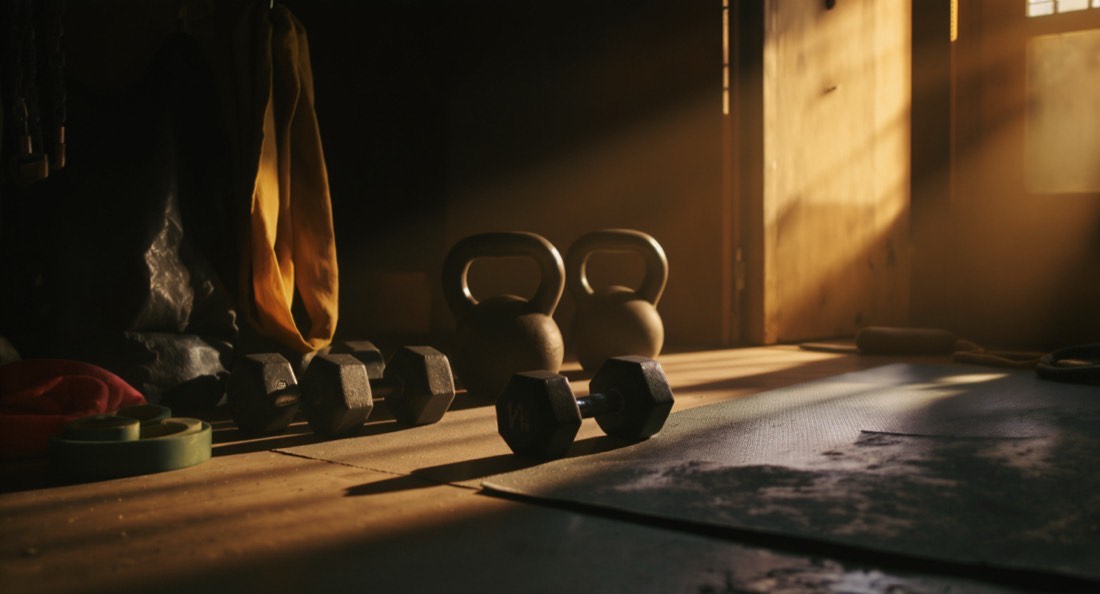
1. A pair of adjustable dumbbells. If you buy one thing, buy this. A set that spans roughly 5 to 50 pounds a side covers years of training for most people over 45, does every major movement pattern, and takes up the footprint of a laundry basket. The adjustable kind costs more than a few fixed pairs and is worth it — the whole point is being able to add weight, and fixed dumbbells either cost a fortune as a full rack or trap you at one load.
2. A bench. Preferably adjustable to incline. It roughly doubles what the dumbbells can do: presses, rows, step-ups, split squats, hip thrusts.
3. A pull-up bar, doorway or wall-mounted. Even if you can't do a pull-up — hangs, band-assisted work and the shoulder benefits stand on their own.
4. Resistance bands. Cheap, light, travel well, and genuinely the best tool for the rotator cuff and glute work that appears throughout this library. A set with a door anchor covers rows, pull-aparts, face pulls, Pallof presses.
5. One heavy kettlebell. Swings, carries, goblet squats. Buy heavier than feels sensible; you'll grow into it faster than you expect.
6. A mat. For everything on the floor, which after 45 is a lot.
That's it. That's a complete gym for most people, for well under the cost of one treadmill, and it fits in a corner.
A squat rack and barbell if you get serious about heavy lower-body work. This is a real upgrade, not a gimmick — but it needs space, a floor that can take it, and ideally someone to check your technique early. Buy it when the dumbbells genuinely run out, not before.
Cardio machines are the most-bought and least-used items in home fitness. Before spending, ask honestly whether you'll use it when you could walk outside for free. If the answer is genuinely yes — bad weather, small children, a bad knee — a bike or rower beats a treadmill for joints. But buy it fifth, not first.
The all-in-one machines sold on television are generally a lot of money for a limited range of movement. The dumbbells do more.
Vibration plates, ab devices, electrical stimulation belts — see the gadgets module.
The two things that most often go wrong at home:
Progression. A gym has heavier weights waiting. At home you own a ceiling, and it's easy to do the same workout for two years and call it training. You need a plan for what "harder" means when you can't add weight — more reps, slower tempo, less rest, harder variations, single-leg and single-arm work. That last one is the cheat code: a split squat makes a 30-pound dumbbell feel like a lot.
Feedback. Nobody's watching your technique. A handful of sessions with a coach early — even remotely, on video — costs far less than the three months you lose to a shoulder you loaded badly for a year.
Friction. The reason people who train at home succeed isn't the equipment, it's that the gym is fourteen steps away and the session happens on the day you'd otherwise have skipped it.
For a lot of people over 45 with jobs, family and a body that needs three sessions a week rather than six, that's the entire ball game.
If you have heart conditions, uncontrolled blood pressure, joint problems, or you've been sedentary a long time — get cleared first. Training alone at home raises the stakes on that, not lowers them. Tell someone when you're lifting heavy alone, and don't do maximal attempts without a spotter or safety pins.
Adjustable dumbbells, a bench, a bar to hang from, bands. Add a kettlebell. Have a plan for making it harder.
Everything else is optional, and the treadmill can wait.
Last updated September 30, 2026