
Health Library / Training
This content is for education only and is not medical advice. I'm a fitness coach, not a physician. Talk to your doctor before starting any medication, hormone, supplement, or new exercise program, especially if you have a medical condition or take prescriptions.
The two things that end training careers after 45 are injuries and quitting, and they're usually the same event. Somebody tweaks a shoulder, takes time off, means to go back, and it's been eight months.
So the most valuable skill at this age isn't pushing harder. It's staying in the game.
You can't skip it anymore. That's the deal.
At 25 you walked in cold and put weight on the bar. At 55 your connective tissue takes longer to get ready, and the first heavy set on a cold joint is where the trouble starts.
What works takes about ten minutes. Get your temperature up — five minutes of something that makes you breathe. Move the joints you're about to use through their range without load. Then work up to your heavy weight in stages instead of jumping to it.
That last one is the piece people skip. Ramping up isn't wasted effort, it's part of the session.
Static stretching before lifting isn't the warmup. Hold your long stretches for after, or on their own.
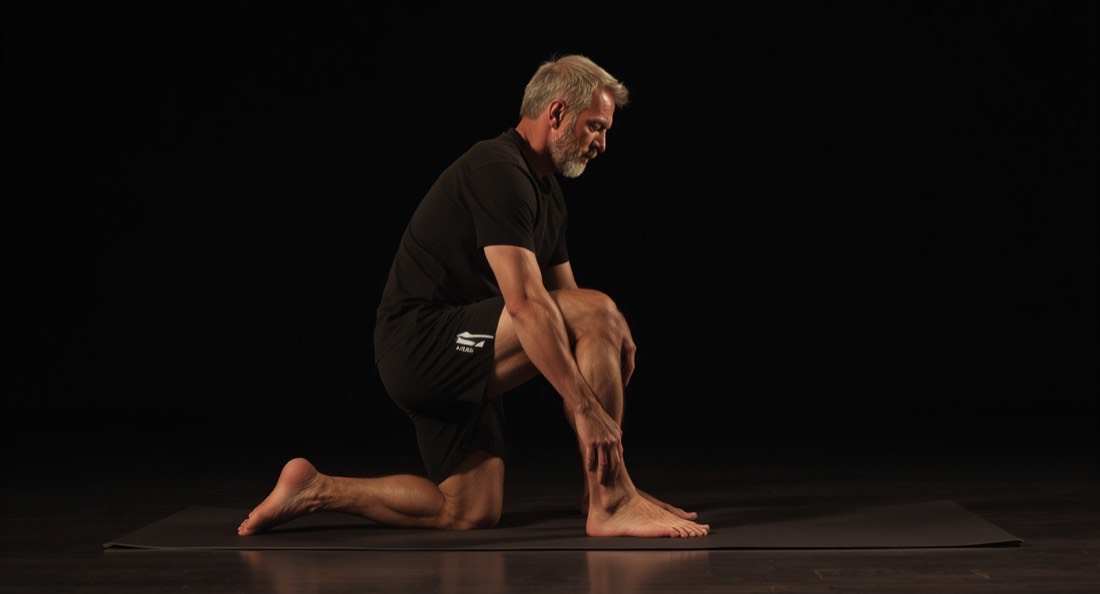
Mobility isn't flexibility for its own sake. Nobody needs the splits. Mobility is having enough range at a joint to do the movement properly, so the load goes where it should instead of somewhere it shouldn't.
The usual suspects over 45: ankles that won't let you squat without your heels lifting, hips that got tight from years of sitting, and a mid-back that doesn't rotate or extend, which is what turns a shoulder press into a shoulder problem.
Work the ones you actually lack. A hip mobility routine won't fix a stiff ankle, and most people are doing the general routine they found rather than the specific thing they're short on.
Falls are the leading cause of injury death in older adults. Not heart disease — falls. And the decline in balance starts decades before anyone takes it seriously, because it doesn't announce itself. Nobody notices that they're slightly worse at standing on one leg at 50 than they were at 40.
The good news is that balance responds to practice quickly, and the practice is almost free. Stand on one leg while you brush your teeth. Do a set of split squats or step-ups where you have to control the wobble. Walk heel to toe. Carry a heavy thing in one hand and walk with it — that's balance, grip and core all at once, and it's the most underrated exercise for this age group.
A minute a day, next to something you'd catch yourself on. That's the whole prescription, and it pays off thirty years out.
The distinction that matters, and the one people get wrong in both directions.
Soreness shows up a day or two after a session, is spread across the muscle belly, feels dull, affects both sides if you trained both sides, and improves once you warm up and move. That's the tissue adapting. Train around it, go lighter, keep going.
Injury tends to be sharp, specific enough that you can point to it with one finger, often on one side only, sometimes came with a moment you remember, and gets worse as you continue rather than better. It's often worse the next morning. It may wake you up.
The rule I give people: if it's sharp, if it's one-sided and specific, or if it's still there in the same spot after a week of backing off, stop guessing.
I've been doing this a long time and I could give you a name for what your shoulder is doing. I'm not going to, and I want to explain why rather than just refusing.
Several very different problems produce nearly identical complaints, and a few of the things that present as a routine training ache are not training problems at all. Telling you it's probably a rotator cuff thing means you spend six weeks treating that instead of getting it looked at. If I'm right, I saved you a copay. If I'm wrong, I cost you months and possibly more than that.
So: a physical therapist or a physician, for anything sharp, anything that isn't improving, anything with numbness or tingling, anything that followed a specific incident, and anything that's changing how you move.
A good PT is the most under-used professional in fitness. They'll usually have you training again faster than rest would, because the answer is rarely total rest — it's loading the thing correctly, which is a different skill from loading it hard.
Get it looked at early. Small problems are cheap.
Last updated September 30, 2026